Tuesday, January 25, 2022
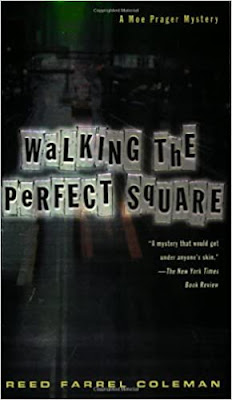
Walking the Perfect Square by Reed Farrel Coleman
In his 2001 novel, Walking the Perfect Square, Reed Farrel Coleman introduced Moe Prager.
Prager, a former officer with the New York Police Department who was forced into retirement after a serious knee injury, now at loose ends. He is not sure what he will do next. His older brother, Aaron, wants him to be his partner and open a family-run wine shop in Manhattan. Prager would not mind being a silent partner in the store, but he cannot see himself in that business.
Then Rico, his partner when he was on the force, calls and says someone could use his help. Francis Maloney, an offensive middle-aged suburban bigot with powerful friends in New York politics and the police department, wants Prager to find his son, Patrick.
A college student, Patrick was last seen at a private party in a Manhattan bar. Witnesses said one minute he was there, the next he was gone. No one saw him go and no one knows where he might have gone. He did not return to his Long Island school, and he did not go home to his parents. Friends looked for him, the police looked for him, his family looked for him, and even though many were still trying to find him, no one had a clue.
After a meeting filled with insults, Prager is not interested in helping the father with anything. But Francis Maloney, through Rico, knows Prager and his brother want their own wine store. Maloney, with his connections, can make their state application sail through the bureaucratic process. Maloney also knows the story of when Prager was a cop he found a missing child and rescued her. Maloney wants Moe Prager’s skill and luck in finding his son.
Prager accepts the job and things get weird quickly.
Patrick, the missing student, was a strange young man, according to guys in his dorm. One of them witnessed, through a partially open door, Patrick walking backwards making a perfect square over and over again. A couple of girlfriends said Patrick was desperate and could be violent.
Moe Prager, who had wanted to be an NYPD detective, uses both his police skills and his personal charm and intelligence, to find people and get them to open up and tell him things they either hid from other investigators or just remembered after talking to him.
As Prager gets closer and closer to finding the missing student, he begins to suspect he is being used by someone or some group for reasons other than finding the kid. Some clues, contacts, and information were just too easy. The mystery of Patrick’s disappearance becomes almost secondary to the mystery of who was out to get who, with Moe Prager in the dangerous middle.
Reed Farrel Coleman is a terrific writer and one of my favorites among current crime novelists. Walking the Perfect Square has a unique structure, starting in 1998 – the recent past for a 2001 book – the story jumps back to 1978, where most of the sleuthing takes place. At times, the story shifts back to 1998 to tease the reader, then dives back into 1978 again. At the end of the initial mystery, Coleman jumps forward to 1998 to wrap up the many mysteries woven into this piece.
Coleman knows the territory and Moe Prager’s first person narration makes the city and the people come alive. There is also a good deal of self-deprecating humor, as when he muses about the stupid accident that caused his knee injury, he quips, “That’s me, Moe Prager, nobody’s hero.” When Moe has to go into a tough, dive bar, he checks that his gun is handy, feeling like Gary Cooper in “High Noon,” only to find, “When I walked in even the flies yawned.”
Most of the time, Coleman’s writing style has the hard feel of a Lawrence Block novel or a Robert B. Parker book.
For a review of Reed Farrel Coleman’s third Moe Prager mystery, The James Deans, click here.
Monday, January 10, 2022
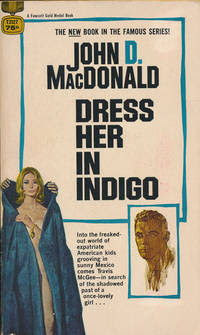
Dress Her in Indigo by John D. MacDonald
More than 50 years after its publication, John D. MacDonald’s 1969 mystery, Dress Her in Indigo, provides a look back at the hippie era, a time that scared the crap out of parents of teenagers.
In this 11th book in the Travis McGee series, the daughter of a wealthy older man leaves college and goes to Mexico with a group of friends and dies in a car accident near Oaxaca.
The man asks McGee and his pal, Meyer, to leave South Florida and go there to find out what the girl was doing, what her life was like, and if she was happy.
(I don’t recall if McGee, the first person narrator, ever calls Meyer anything other than Meyer, or lets the reader know Meyer’s first name.)
McGee and Meyer hop a flight and get to work seeking out young Americans, asking about the girl, picking up her trail and learning about her “friends.”
Author MacDonald was about 52 or 53 when he wrote Dress Her in Indigo, so he, and his 40-ish protagonist, McGee, were the older generation observing the younger. While he tried to give the hippies the benefit of the doubt by painting some of them as lost and confused, or industrious artists doing their own thing, there was a distinct smell of disapproval coming off the pages.
Not that all bohemian types repelled McGee. At one point he hooks up with a slinky, rich European woman who lives for sex, and nearly kills him with her requirements in the sack. Meyer, too, finds some free love with a very young Mexican woman.
Soon, McGee uncovers disturbing facts about the dead girl’s car accident and starts digging into the case.
The mystery is less interesting than MacDonald’s portrait of the self appointed leader of the girl’s group, an intense, charismatic con man.
Was art imitating life here? Did MacDonald write the book after the Tate–LaBianca murders of August 1969. Or was MacDonald predicting this type of character emerging?
Wednesday, December 15, 2021
Nightmare Alley, new film from strange book
Director Guillermo del Toro’s new film version of “Nightmare Alley” is about to open in theaters.
The movie stars Bradley Cooper, Cate Blanchett, Toni Collette, Willem Dafoe, Rooney Mara and a lot of other big names.
Here’s hoping it is as good as director Edmund Goulding’s 1947 version starring Tyrone Power, Coleen Gray, Joan Blondell and Helen Walker.
And here’s hoping it sticks closer to the unsettling weirdness of William Lindsay Gresham’s 1946 novel of the same name, but without going too far off the deep end, as Guillermo del Toro is apt to do.
A few years ago, I wrote a piece about the novel. You can read it here.
Thursday, December 9, 2021
Christmas Party by Rex Stout
Around here, Christmas trees went up and houses got decked out with colored lights before Thanksgiving. It is the holiday season.
In that spirit, I picked up a copy of Rex Stout’s, Christmas Party, a Nero Wolfe mystery set during the yuletide.
Private detective Nero Wolfe’s right-hand man, Archie Goodwin is attending a Christmas party at the offices of a former client when the host is murdered right in front of a roomful of guests.
The suspects are many, including disgruntled employees, jealous benefactors, and a mysterious figure in a Santa Claus costume tending bar at the time.
Since the host seems to have been poisoned from a bottle no one else drank from, Kris Kringle becomes the No. 1 person of interest. But Santa slipped away in the chaos as the others tended to the downed host.
Archie is embroiled in the mystery as he was romancing a young woman employed at the company. Another young woman employee involves Nero Wolfe in the case.
Both Archie and Wolfe know things related to the company and its people that they each would like to conceal from the police. The only way to do that is for Nero Wolfe to solve the mystery and reveal the killer before Inspector Cramer of the New York Police Department pounces on the wrong suspect.
This is the perfect holiday read: not too long, none of the Nero Wolfes are, but this one is a novella; not too graphic, again, none of them are; and, while the brilliant, beer-drinking, flower-loving, gourmand, Nero Wolfe is an overbearing pain in the ass, sharp-witted, street-smart Archie Goodwin is always good company. 
Rex Stout (1886-1975) published Christmas Party in 1957.
Monday, November 15, 2021
Fourth Down and Out by Andrew Welsh-Huggins
Hayes is a PI with an unusual past.
As a college football star for the Ohio State University, he was involved in a scandal that ended his career and made him one of the most hated personalities in Columbus, Ohio.
Now, 20 years later, avid fans of the team still recognize Andy and let him know, loudly, just what they think of him.
Andy primarily works for a local lawyer, who needs detective work or has clients who need it.
In this case, a middle-age man caught on video with a high school girl finds himself being blackmailed. He contacts Andy to find the blackmailer and erase the video. Fortunately, the movie has not hit the web. It resides on a laptop that proves difficult to find.
Other people want the machine and just as Andy gets his hands on it, he is jumped by to thugs hired to retrieve it. One of the thugs, a football fan, recognizes Andy and gives him an extra hard thumping.
The thug is later found murdered, further complicating the case.
Andrew Welsh-Huggins, an Associated Press reporter, lays out a complicated plot with many twists and turns, running his protagonist all around the city, the burbs and the countryside. He also fills the book with a fine sense of what big-time college football means to the residents of the area.
So far, there are seven books in the Andy Hayes series.
This series was highlighted recently (here and here) by my friend Col, at his site Col’s Criminal Library, a great source for finding out what’s new in crime fiction.
Sunday, October 31, 2021
Wolfshead by Robert E. Howard
Today, a repost and a request.
While
I am familiar with some of the classic werewolf stories, if you can
suggest more – classic or not – I would appreciate
it.
Happy Halloween.
It is a werewolf yarn, and since the Wolf Man was my favorite of the old movie monsters, and with Halloween approaching, I thought this novella (or is it a novelette?) would make a good Forgotten Books post this week.
The time of the story is not stated, but best guess puts it in the 17th or early 18th century. A former soldier travels to Africa to visit an old friend who has grown rich by shipping goods to Europe. The friend is also involved in the slave trade, which contributed to his wealth. At the castle of the friend, the unnamed narrator meets a variety of guests, one of whom turns out to be a werewolf. This werewolf, like all werewolves of future stories and movies, knows what he becomes at night and desperately longs to be rid of the curse or to die.
The first half of this story is a horror mystery as the narrator and the surviving guests try to figure out who – and what – is attacking them at night. The second half of the story is the surprising reveal and explanation, followed by some fine action as the werewolf goes on a rampage.
The story is written in a formal style with a dark, chilly tone, and Howard ’s talent keeps it from bogging down. His action passages are excellent and his rethinking of the werewolf legends is an intriguing twist.
This shorter piece is worth reading and can be found on-line.
Friday, October 15, 2021
A Small Sacrifice by Dana King
Former Chicago cop, Nick Forte, takes on the job of clearing the name of a man everyone believes guilty of murdering a child.
State and local police bungled the investigation and could not prove the man strangled his own six-year-old son.
The killing made headlines the previous year when the man found the child’s body in the basement of the family’s huge suburban home.
Now, his mother, a wealthy, obstinate, battle axe, wants to restore the good name of the family. She hires Nick for the task.
Nick hates the case, but money is money.
He tells the mother he cannot promise he will get any further than the police. The woman says she does not want Nick to solve the case, just do enough to change public opinion about her son.
Nick barely begins snooping when someone he wants to interview winds up dead in the trunk of a car. Before he can dwell on the odd possible connection to the case, a hired killer attempts to assassinate Nick on the streets of Chicago. The hitman has mob connections.
Once Nick Forte steps into mob territory, the level of tension in the story goes up tenfold. Mobsters get annoyed when outsiders stick their noses into their carefully concealed illegal businesses.
But what is the connection between the mob and his client's arrogant son, Nick wonders?
Dana King spins a complex tale of crime and corruption in a fast paced story with a just the right amount of humor – usually provided by Nick’s first person comments.
At one point, Nick Forte has to talk face to face with a powerful mob boss. Nick says, “I forced myself to make eye contact. It was like looking down the staircase to hell.”
There are four more novels in King’s Nick Forte series.
For a glimpse at Dana King’s other series, the Penns River police novels, look here and here.
Thursday, September 30, 2021
Clint Eastwood’s “Cry Macho” is a film to see, if . . . . . .
If you can get past the idea that anyone would ask a 90-year-old man to drive down to Mexico to rescue a teenage boy, then you will have a fine time watching the new film, “Cry Macho,” starring and directed by Clint Eastwood.
We did.
Others did not. Some friends and some critics disliked this film.
After starring in nearly 50 movies and directing 45 films – often doing double duty in front of, and behind the camera – if Clint Eastwood makes a picture, I am going out to see it. He is one of America’s greatest living directors. There have been some missteps along the way. “Cry Macho” may be one of them. But I found enough in it to enjoy.
It is hard to think of any one as old as old Clint acting in and directing the same movie.
Mel Brooks comes to mind. But the last film he both directed and starred in was, “Dracula: Dead and Loving It” (1995) when he was 69 or 70. Woody Allen both directed and starred in “To Rome With Love” (2012) when he was about 76.
Roman Polanski is someone I think of as appearing in a lot of his own pictures. But that perception is wrong, except in a few instances and a bunch of cameos or Hitchcock-like appearances. The last time he starred in his own film was 1976’s “The Tenant.”
Actors have continued working into their 80s and 90s – the late Christopher Plummer did, and Judi Dench, at 86, is in Kenneth Branagh’s new film, “Belfast.”
Some directors continued working as senior citizens. Ridley Scott, 83, will have two movies out this year.
The oldest director I ever heard of making feature films was Manoel de Oliveira. Five years ago, I did a post about Eastwood and Oliveira (here).
Film Comment magazine published a list of the oldest directors (here).
But, as far as I know, no one Clint’s age has both directed and starred in the same movie.
Thursday, September 23, 2021
Another Look at Out of Sight by Elmore Leonard
His 1996 novel, Out of Sight, is still a fast, breezy read with well drawn characters, tons of suspense, and swift violent action that hits you like a smack in the face.
Out of Sight is the story of wanted bank robber Jack Foley and federal marshal Karen Sisco who is hunting for him.
Jack and Karen first meet outside a Florida prison when she arrives just as he pops up out of an escape tunnel. Jack, and a buddy waiting for him, overpower Karen, put her in the trunk of her own car and then Jack climbs in with her.
Snuggled up to each other for the getaway, they get to talking as if on a date.
This may sound familiar because director Steven Soderbergh made a good movie from it with George Clooney as Jack and Jennifer Lopez as Karen.
Karen gets away from Jack and Jack gets away from the law. But there was a weird kind of connection between them in that trunk and each wants to see the other again.
Jack and his buddy, Buddy, drive from Florida to Michigan and get with some violent gangsters planning to rob a mansion. Karen gets a line on Jack and tracks him to Detroit.
Why two cool bank robbers like Jack and Buddy would get involved with this new plan is the biggest mystery in Leonard’s crime story. But the author’s skill and style makes it easy to overlook that little problem.
The main thing that diverts a reader’s attention from the hitches in the plot is the budding love story between Jack and Karen. The savvy, middle aged, and very smooth bank robber is smitten with the young, attractive fed. The danger of falling hard for her is whether Karen will fall for him or snap the cuffs on him.
At its heart, Out of Sight, is a romance novel and an example of what can happen when the master of one genre dips into another.
Wednesday, September 15, 2021
The Card Counter is a Film to See
Paul Schrader’s, “The Card Counter,” is a raw, yet strangely quiet, movie about a former soldier, psychologically damaged by his time in Iraq. His guilt and fears, which he keeps hidden behind a stony stare and immobile face, are not the result of battle, but of the things he did while a guard in Abu Ghraib prison.
The soft spoken, stone-faced character, who now makes a living as a professional gambler, is played by actor Oscar Isaac, and he is unnerving to watch.
There is a great deal of stillness in “The Card Counter,” but a tremendous amount of inner turmoil, which can set a viewer’s nerves on edge waiting for the explosion.
Schrader, who wrote and directed this film, is the guy who wrote the script for the 1976 Martin Scorsese film, “Taxi Driver.” Here, Schrader uses some of the same techniques in “The Card Counter,” including an alienated protagonist who tells us about himself in voice-over narration.
Unlike Robert De Niro’s edgy taxi driver who observes the world around him and comments on it, Isaac’s gambler is quietly involved in his world of intense card games. He sticks to low stakes games in casinos around the country which, in this film, appear slick, serious, empty and devoid of any kind of fun.
This new Schrader character, like the old one, is compelled to be alone, but longs to connect with other people – and with the viewers of the film. He even tells us how he changed his name from William Tillich to William Tell. Is the name Schrader’s way of letting us know William wants to “tell” us what’s eating at him? Is it a play on the poker term meaning body language that tips other players to the cards one is holding. Is the name a reference to the legend of the archer who shot an apple off his son’s head? In the movie, William forms a dangerous friendship with a volatile young fellow with an ax to grind against the people who plunged the country into the war in Iraq.
The film poses lots of questions. It answers many of them, but leaves quite a few mysteries. (Like, what was up with those bed sheets? Sensory deprivation?)


