Tuesday, March 9, 2021

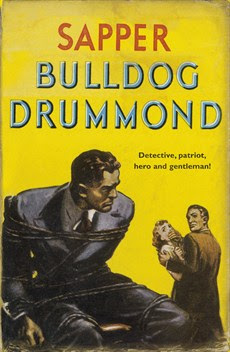
Bulldog Drummond by H.C. McNeile


In H.C. McNeile’s 1920 adventure novel, Bulldog Drummond, Captain Hugh Drummond, back in England after years in the trenches on the Western Front, finds life in peacetime London boring.

Looking for something interesting, challenging and dangerous to do, he places the following ad in a newspaper:

“Demobilized officer, finding peace incredibly tedious, would welcome diversion. Legitimate, if possible; but crime, if of a comparatively humorous description, no objection. Excitement essential.”

Several responses come in, but the one that intrigues him is from Phyllis Benton, a young woman whose father has fallen into the hands of manipulative criminals.

These bad guys are led by a cunning mastermind called Carl Peterson – which may or may not be his real name – a European gathering a group of agents to disrupt British industry and the government.

McNeile uses Peterson’s plan the way Alfred Hitchcock used his McGuffin. For the director, the word meant the thing the bad guys want which puts the story in gear, but that the audience (in this case the readers) do not care about. The McGuffin in Bulldog Drummond should not be analyzed too closely.

The bad guys are using a mansion close to Phyllis’ home as their base of operations. Drummond takes up the challenge but soon finds he is up against a larger force than expected. To combat Peterson’s henchmen, he calls on his pals who served with him in France. They, like Drummond, jump at the chance for a little action.

As he gathers his troops, Drummond’s friend Algy Longworth tells him, “Toby Sinclair is running round in circles asking for trouble Let’s rope him in.”

Beyond the tongue-in-cheek romp of their adventure, the glimpse of post-war veterans was interesting.

Bulldog Drummond is lightweight stuff. But a lot of it will test a reader’s ability to suspend disbelief. The two wackiest instances are when Drummond discovers a secret room in the bad guys’ headquarters is guarded by a cobra, and when the baddies sick a gorilla on Drummond. These enemies of England spend a lot of time dreaming up bizarre ways to kill Drummond when they could have shot him and dumped his body in the woods.

The character, Bulldog Drummond, has been compared to James Bond. But reading this book, I pictured a younger John Steed, the character played by Patrick Macnee in The Avengers TV series.

Readers today may be offended by the intolerant attitudes of Drummond and his friends. While I picked up the book for a breezy read, there are passages that jumped off the page and made me think we have come a long way in 100 years from the prejudices of the past. But have we?

Herman Cyril McNeile (1888-1937), who wrote under the pen name “Sapper,” turned out this first plus nine more Drummond novels. An additional nine were by other authors. The Bulldog Drummond character was adapted for film, radio and television. McNeile died of cancer at age 48.

Tuesday, March 2, 2021

Film Noir “I Wake Up Screaming” from a novel by Steve Fisher

In the debate over identifying film noir and its beginnings, John Huston’s “The Maltese Falcon” from the Dashiell Hammett novel is just about the first. But so is “I Wake Up Screaming.” Both pictures opened in October 1941.

“Falcon,” is the far better film. But, despite problems with its screenplay and its presentation, “Screaming” has a lot going for it.

Based on a crime novel by Steve Fisher (my post about the book can be found here), the film version of “I Wake Up Screaming” changes the locale from Los Angeles to New York City, and the main character from a screenwriter to a sports promoter. I have read that Darryl Zanuck, boss of 20th Century Fox in those days, would not make movies about the movie business.

In the film, as well as in the book, a beautiful young woman is murdered and the man she has been seeing is the prime suspect. While the man tries to clear his name, one police detective is obsessed with the idea of sending the him to the electric chair.

Victor Mature plays the man and in an excellent casting decision, Laird Cregar plays the detective. Mature was a big guy who looked like a body builder and not the type who would be intimidated. But Cregar was a huge, heavy-set actor who looked like he could squash Mature. Cregar bravely played the role without a hint of begging the audience to like him. The detective is malevolent and scary.

In the book, the detective is emaciated and dying and like a ghost he haunts the man. One of the movie’s creepiest moments is when the man wakes in the middle of the night to find the detective sitting in a chair next to his bed, watching him.

Another oddity about the movie is the casting of rising musical-comedy star Betty Grable as the leading lady. She plays the sister of the murdered girl.

But the strangest thing in “Screaming” is its music. It uses – make that overuses – an instrumental version of “Over the Rainbow.” I cannot guess why the producers used such a recognizable tune associated with another movie.

“I Wake Up Screaming” was directed by Bruce Humberstone with too many light, even comedic moments. Humberstone is not known for film noir. Today he may not be known at all. But, he was a craftsman of the old school who directed a wide variety of productions including Westerns, comedies, and a lot of television later in his career. In the 1930s, he directed four of the Charlie Chan pictures. Those little films, if my memory is correct, usually had some dark, noir-like photography.

“Screaming” has some excellent high-contrast, black and white cinematography thanks to cameraman Edward Cronjager.

As for the debate over what constitutes film noir, I will just adopt Potter Stewart’s test for pornography and simply say, I know it when I see it.

(In 1964, U.S. Supreme Court Justice Potter Stewart, wrote that phrase in an opinion on whether or not French director Louis Malle’s film, “The Lovers,” was obscene. Stewart said it was not.)

Monday, February 22, 2021

I Wake Up Screaming by Steve Fisher

For some reason, author Steve Fisher rewrote his 1941 novel, I Wake Up Screaming, and republished it in 1960.

Sources on-line say he wanted to update the book from the early 1940s to the late 1950s.

This is the beginning of the 1941version:

It was a hot Saturday night and I wore white flannels and one of those blue sport shirts and sat in the Roosevelt Hotel’s Cine-Grill drinking Bacardis. The bar stools were white leather, and the wall decoration was a maze of old film cuts blown up – Charlie Chaplin, Jackie Coogan, Milton Sills, Harold Lloyd, Wallace Beery and like that. Across the street at The Chinese they were having a minor premiere of the newest Dr. Kildare picture. Arc lights were swinging back and forth, limousines arriving, and cops holding off the crowd.

And this is the update:

It was a hot Saturday night and I had on a Sy Devore suit and a hand-knit tie and sat at the bar in Mike Romanoff’s drinking Canadian Club old fashioneds. The bar stools were leather and the wall decorations had that ultra look and Zsa Zsa Gabor was at a closeby table, her head thrown back in laughter, and Gary Cooper and Bing Crosby and Bill Holden were at other tables and a couple of blocks away, on the corner of Wilshire and Beverly Drive, they were having a premiere for the latest Jerry Wald epic: arc lights swinging back and forth, limousines arriving, and cops holding off the crowd.


A lot of pop references are different in the later work, but the story is essentially the same.  

I Wake Up Screaming is about a young writer working at one of the big studios who meets Vicky, a beautiful young woman who also works there. They start going out together, but Vicky is murdered and the police jump to the conclusion that the writer did it.

One detective, Ed Cornell, has it in for the writer and makes no secret that he wants to put him in the electric chair. Cornell is a ghostly presence, he looks like death, skeletal, pale and sickly. The man is dying and knows this is his last case and promises to live to see it through. Cornell shadows the writer and appears out of nowhere in unexpected places to haunt the writer.

Fisher does an expert job of plunging the reader into the dark, murky, nightmarish world in which the writer finds himself.

Monday, February 15, 2021

“The Midnighters” is a Movie to See

Until recently, a little crime film from 2016 called “The Midnighters” was unknown to me.

It is the story of Victor, an older man who spent the last 30 years in prison. No sooner is he released than he is pulled back into crime.

The guy pulling him is his adult son. The son is mixed up with some very bad guys who want to pull off a big heist. All the son and his cohorts need is an ace safe cracker. That is where Victor comes in.

Leon Russom plays Victor and he is terrific. In fact, all the acting in this picture is top notch.

“The Midnighters” was written and directed by Julian Fort, and for a first feature, it is extremely well done.

The movie is available on the streaming site, Kanopy.

Monday, February 8, 2021

The Sins of the Fathers by Lawrence Block

Forty-five years ago, master craftsman Lawrence Block kicked off his long-running series of novels featuring Matthew Scudder with The Sins of the Fathers.

The compact book starts with hard drinking, former cop turned unlicensed investigator, Scudder in a bar and meeting with the father of a murder victim.

A young woman was slashed to death in her Greenwich Village apartment. The man she lived with was found moments later out on the street, covered in blood and shouting obscenities. The guy was arrested and taken to the city detention center called the Tombs where he committed suicide. Case closed, as far as the police were concerned.

But the father, who had lost touch with the girl when she dropped out of college, pays Scudder to find out what his daughter’s life had been like in the past few years. The newspapers called her a prostitute.

Scudder learns the girl had been a prostitute, the man she lived with could not have killed her and the case was not resolved.

Block’s prose is tight and his dialogue natural. This lean book provides readers with everything they need to know about the girl, the father, the suspects, and about Scudder, including why he quit the force.

The Sins of the Fathers, with its blunt descriptions of sex and death is still hot read today.

There are 11 novels in the Scudder series, which you can see at Lawrence Block’s website. Over the years, I’ve read a bunch of them, but not in order. Now, I plan to work my way through the books.

Monday, February 1, 2021

Film Noir “Thieves’ Highway” from Bezzerides novel

Richard Conte, Lee J. Cobb

Last week, I posted a piece about A. I. Bezzerides’ hard-boiled 1949 novel of independent truckers, Thieves’ Market.

The same year the book was published, 20th Century Fox released a film version of the story re-titled, “Thieves’ Highway.”

Bezzerides, in an interview, said the studio did not want to offend the city of San Francisco by using the original title.

The producers made other changes as well, the biggest of which was making Nick Garcos a hero rather than the nasty anti-hero of Bezzerides’ book.

In the film, he no longer steals from his mother to set himself up in the trucking business, but becomes an independent hauler partly as an act of vengeance to right a wrong done against his father.

With the revisions to the character, the studio cast one of its up and coming players, Richard Conte, in the role. Conte was a good – if underrated – actor. He later slipped into supporting roles, perhaps because his stoic demeanor fell out of style with the influx of emotionally charged Method actors arriving in Hollywood.

Lee J. Cobb, a gruff stage actor (he played Willy Loman in the original Broadway production of “Death of a Salesman”), was cast as the crooked produce buyer who attempts to hijack Nick’s load. Cobb was great in this kind of part. He also played the union boss in “On the Waterfront.”

Millard Mitchell, a character actor who usually played sheriffs and generals, was cast against type as Nick’s unscrupulous and untrustworthy partner, and he does a great job.

Valentina Cortese played a hooker with the heart of gold who is hired to distract Nick while the buyer commandeers his load.

Jules Dassin directed the picture in an almost documentary style. Dassin at that time was known for making tough, hard-boiled films like “The Naked City” and “Brute Force.” Later, after being blacklisted, he directed the heist film “Rififi” in France, and the comedy-heist film “Topkapi” in Greece and Turkey.

Bezzerides may not have minded the changes the studio demanded of his book since he has the solo credit for writing the screenplay. Besides, “Thieves’ Highway” was a lot closer to the book than the Warner Bros. production of his 1938 novel about truckers, Long Haul, re-titled, “They Drive by Night.” But that is a story for another post.

Monday, January 25, 2021

Thieves’ Market by A.I. Bezzerides

The harshest, ugliest book read last year was Thieves’ Market by A. I. Bezzerides.

This 1949 novel is about independent truckers and the many scams and rip offs that they pull, and that get pulled on them.

Nick Garcos, a young man with a miserable job, a miserable girlfriend and a miserable widowed mother, steals the insurance money the old lady got when his father died and buys a truck so he can be his own boss as an independent produce hauler.

He teams up with a hardened trucker and together they buy two truckloads of apples from a farmer. When his partner tries to cheat the grower, Nick steps in and pays the man.

The two truckers head north to San Francisco to sell their combined loads at the produce market.

Along the way, there are mishaps with the old trucks and Nick arrives in town first. While waiting for his partner to arrive and negotiate a deal for the apples, a tough, crooked buyer sizes up Nick as easy prey. He pays a local hooker to distract Nick so the buyer can hijack his load.

Bezzerides knew his subject either from experience in his youth or from a great deal of research. Thieves’ Market feels like the real deal from the plot to the characters to the dialogue.

As he did in his earlier novel about the tough life of truckers, Long Haul (1938), Bezzerides writes in scenes that are vivid and alive. He makes the reader feel every bump in the road.

An unforgettable section is when Nick, on a lonely, dark stretch of highway, blows a tire. Not sure how far behind his partner is, Nick decides to change the flat himself. While under the truck, the jack slips and the truck comes down pinning Nick into the soft dirt. Unable to move and having difficulty breathing, he watches as the few vehicles on the road pass by without slowing down while he is stuck and dying.

Albert Isaac “Buzz” Bezzerides, (1908-2007) wrote three novels. Both trucking stories were bought by Hollywood and produced as movies. Bezzerides spent most of his career writing film and TV scripts.

Thieves’ Market is well worth the time to find and read.

Monday, January 4, 2021

Flawless is a clever heist film


In the 2007 movie “Flawless,” a night janitor has an improbable plan to rob his employer. The employer is the headquarters of a diamond cartel.

To help him, he recruits a woman executive who is pissed at the company.

The challenge is overwhelming and the twists and turns here are clever and will keep a viewer guessing.

The always terrific Michael Caine as the janitor and Demi Moore as the executive propel this unusual heist picture.

The film was directed by Michael Radford and written by Edward Anderson (who I am pretty sure is not the Edward Anderson who wrote the 1937 crime novel Thieves Like Us.)

“Flawless” is available on the streaming site Kanopy.

Wednesday, December 23, 2020

A Film Noir Christmas Carol


This week, I am looking forward to watching – for the umpteenth time – the 1951 version of “A Christmas Carol.” It is the one starring Alistair Sim as Scrooge and the one I consider the best of the bunch.

Sim looks like he is having the time of his life playing the old skinflint. Director Brian Desmond Hurst keeps the actor on course and the sentimentality under control, especially in the Tiny Tim scenes and the flashbacks of the young Ebenezer. He also keeps the action clipping right along as he shoves Scrooge into some wonderfully nightmarish sequences.

The fright and anxiety of Scrooge, the high contrast black and white photography and the moody sets, place Charles Dickens’ 1843 novella in the world of film noir.

Its depiction of 19th century England could also group it with director David Lean’s two terrific Dickens films, “Great Expectations” (1946) and “Oliver Twist” (1948).

Anyone who has not seen it, should look for it and watch it. Anyone who has seen it will probably watch it again.

Here’s wishing you a Merry Christmas and a Happy Holiday Season. Hope you will visit this page again in the New Year.


Monday, December 14, 2020

Guilty Bystander by Wade Miller


If Bob Wade and Bill Miller (writing as Wade Miller) set out to create one of the most noir of noir novels, they achieved their goal – although they came perilously close to parody with Guilty Bystander.

The writing partners poured everything into this one. There is a drunken, down-and-out detective, a seedy hotel, a femme fatale, a good girl who could be more “fatale” than the other woman, a kidnapped child, a fortune in missing jewels, a bunch of rival gangsters, a couple of mysterious murders, and a lot of violent action.

Oh yeah, and rain. It rains all the time in this not-so-sunny California setting.

One morning, Max Thursday, wakes with a world-class hangover to find his ex-wife in his shabby hotel room with bad news. Their little boy has been kidnapped and her new husband, a doctor, has disappeared.

Max sets out to find the boy. The clues he picks up keep leading him back to a woman named Angel who, coincidentally, lives in his hotel. Angel knows far too many shady characters.

In the course of the 144 pages of the Signet paperback I picked up somewhere for a buck (original price, 25 cents), Max gets framed, beaten, tortured, and dunked in the ocean – twice – before putting the puzzle together, recovering the child and solving the murders and the mystery of the jewels.

Bob Wade (1920-2012) and Bill Miller (1920-1961) wrote more than 30 novels together, including Kiss Her Goodbye  (see here) and Kitten With A Whip (see here). There is more about them at Thrilling Detective.

(For more posts on books, head over to Todd Mason’s blog.)
(And remember, my book,
Lyme Depot, would make a great gift for a crime reader.)