Showing posts with label Doris Day. Show all posts

Tuesday, May 14, 2019

R.I.P. Doris Day

Film, TV, and recording star Doris Day died Monday at age 97.

She was a big-band singer in the 1940s, starred in movies beginning in 1948, and was a top box office draw in the 1950s and early 1960s.

In 1960, she was nominated for an Academy Award for the comedy, “Pillow Talk” (1959). She also should have been nominated for the 1955 drama “Love Me Or Leave Me,” and for her performance in Alfred Hitchcock’s 1956 version of “The Man Who Knew Too Much.”

Doris Day starred in her own television series for five seasons (1968-1973), then retired from show business and devoted her time to her animal welfare foundation.

Of the many, many songs she recorded, this version of “Again” is my favorite:

Tuesday, October 17, 2017

Cagney & Day in "Love Me or Leave Me"

Doris Day and James Cagney
The 1955 MGM production, “Love Me or Leave Me” is a James Cagney gangster movie and a Doris Day musical, and the two elements work well together. It is also one of my favorites.

Based on the life of 1920s singer Ruth Etting, the story opens with Ruth, played by Miss Day, working as a dime-a-dance girl in a cheesy Chicago club when she is spotted by tough-guy Marty “the Gimp” Snyder. Marty is the owner of a legitimate laundry that illegitimately forces nightclub owners to use his service, thus making this intimidating thug rich and powerful. Marty is smitten by tough-cookie Ruth and introduces her to his clients securing her jobs in the chorus and then as a featured singer.

Ruth Etting has talent, but she uses Marty for his connections to advance her career. She falls in love with a musician, played by Cameron Mitchell, who urges her to get away from the gangster before it is too late. Ruth puts her career first and ends up marrying Marty.

As she rises in fame, Marty fearing he is losing control of her, causes problems everywhere she works.

Cagney, as Marty, is great as usual and is possibly more ferocious here than in his portrayal of psychopath Cody Jarrett in “White Heat.” He is also more understandable, even sympathetic, than any of his other gangster roles. Doris Day gives her best performance ever as the determined Ruth. Any other actress attempting this role would have been hated by the audience, but due to Miss Day’s charm and voice, she wins viewers.

“Love Me Or Leave Me” was directed by Charles Vidor, who made the 1946 noir classic “Gilda.” It was produced by Joe Pasternak, one of the three staff supervisors of MGM musicals.

The picture features plenty of Ruth’s 1920s songs, updated to Doris Day’s style, including the tough, “Ten Cents a Dance,” along with “At Sundown,” and this simple version of “I’ll Never Stop Loving You.”

Monday, December 12, 2016

Hitchcock Times 2: Man Who Knew Too Much

Alfred Hitchcock is one of the few movie directors of the past who, decades after his death in 1980, is still well known.

In the 1950s, Hitchcock, at the height of his powers and popularity, remade one of his earlier films. Some might say Hitchcock remade many of his films, just giving them different titles, but that would be unfair, and would definitely be the subject for another post.

The film he remade was “The Man Who Knew Too Much.”

In the 1934 original, produced in England, a family – mother, father, and little girl – on vacation in the snowy mountains of St. Moritz, Switzerland, get tipped off to a planned murder. The villains, discovering that the parents could notify the authorities about their plot, kidnap the little girl to keep them quiet. The father and mother learned that the baddies plan to assassinate a foreign diplomat in England during a concert at London’s Royal Albert Hall. The couple is faced with the choice of either saving the diplomat and possibly avoiding a war (remember, World War 1, which ended just 16 years earlier, was touched off by an assassination) or saving their daughter.

In the1956 remake, a family – mother, father, and little boy – on vacation in Marrakesh, Morocco, learn of a mysterious plot, which turns out to the be the same scenario as the earlier version.


Both films feature women with extraordinary talents. Edna Best, as the mother in the first film, is established as a crack shot with a rifle, which plays directly into the strange shootout with the villains at the end of that picture. Doris Day in the remake plays a singer who gave up her career when she married a doctor, played by James Stewart, and her voice plays an important part in the recovery of her boy.

Edna Best, was a London stage star who did not make many movies, and in this film, Hitchcock did not give her much to do. Doris Day, on the other hand, is given many scenes that establish her character, her talent and her rapport with the boy and with Stewart. In the opening scenes, Doris Day and James Stewart seem to be improvising, although that is not likely in one of Hitchcock’s films. They also have a powerful scene together when Stewart, who learns of the kidnapping first, has to break the bad news to his wife. (Anyone who thinks Doris Day was just a pretty comedienne with a good singing voice, should check out that scene and reconsider.)
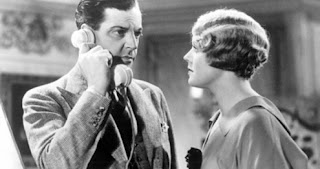

The original version, with a running time of 75 minutes, seems rushed and does not give an audience time to get to know the family. When Hitchcock went to remake the story, 22 years later, he had a solid reputation and the backing of a major Hollywood studio and took his time, allowing the audience to care about the people, and more importantly, allowing the tension to build. The 1956 version runs 120 minutes. It was also shot in color and in Vista Vision and was made partially on location in Morocco and England.

But despite the short running time of the original, Hitchcock presents a typical Hitchcockian scene during the parents’ search for the girl. The scene is both painfully uncomfortable and hilarious at the same time. It involves a visit to a sinister dentist. In order to extract information (I know, I know), the dad first has to get into the chair.

Later, Hitchcock inserted a scene into the remake, at about the same point in the story, that was both tense and funny. Following up on a lead, Jimmy Stewart goes to a taxidermist’s studio and winds up in a fight with the employees among the stuffed exotic animals.

Peter Lorre, as the bad guy who kidnaps the child in the original film, was great. His performance is so odd and weirdly humorous that he steals every scene from Leslie Banks, who plays the father. In the remake, Hitchcock toned this down, making the kidnappers a bland, middle-aged couple.

For fans of Hitchcock, both versions are a must see. But the remake is far superior to the original.

In an interview with French New Wave director Francois Truffaut, Hitchcock said the first version was the work of a talented amateur and the second was the work of a professional.

(For more posts on movies and TV, check out Todd Mason’s blog.)

Monday, November 7, 2016

Storm Warning, musical-comedy cast in film noir

“Storm Warning,” a Warner Bros. picture from 1951 about the Klan in a southern town, is a combination of “Black Legion,” the studio’s 1937 Bogart movie on that subject, and “A Streetcar Named Desire.”

Marsha, a fashion model, played by Ginger Rogers, traveling across the country makes a detour to a small town for a quick visit with her sister Lucy, played by Doris Day.

Marsha is not in town 10 minutes before she witnesses a gang of Klansmen drag a man from the county jail and shoot him down in the street. Hiding in a doorway, Marsha plainly sees two men whose hoods have come off.

Shaken, she meets her sister, Lucy, and Lucy’s new husband, Hank, played by Steve Cochran. Hank was one of the men she saw.

To protect her sister and to get away from her new brother-in-law, Marsha plans to get out of town early the next morning. But county prosecutor Burt Rainey, played by Ronald Reagan, has Marsha picked up and questioned as a witness.

Things heat up for Marsha, Lucy and especially Hank, who is part bully, part simpering coward, when both the prosecutor and the leader of the Klan lean on them.

And when things could not get worse, Hank tries to rape Marsha.

From there, the film slips into an old formula and while not a happy ending, it is not as hard-hitting and memorable as it could have been.

One of the problems is Ronald Reagan. His part is not well written and Reagan was always better as an amiable second lead to stars like Errol Flynn. Doris Day, on the other hand, was a good choice for the young wife so in love that she cannot see that her hubbie is a lout. Ms. Day was a much better actress than people remember. This is also one of Steve Cochran’s better films. Usually cast as a gangster in movies like “White Heat,” here he gets to do a lot more with the part of a wannabe tough guy.

The picture was directed by Stuart Heisler, a Hollywood veteran, who in 1940 made the excellent feature, “The Biscuit Eater.” Heisler does a good job with the material he is given, and brings a taught, noir feeling to the film. The night scenes leading up to the killing are dark and moody, thanks to cameraman Carl Guthrie.

“Storm Warning” was written by Daniel Fuchs, who wrote the screenplay for the 1949 noir classic, “Criss Cross,” and Richard Brooks, who had a long career in Hollywood first as a writer and later as the writer-director of films like “In Cold Blood” and “Blackboard Jungle.”

This fast-moving, 93-minute movie is well worth a look.


(For more on film and television, visit Todd Mason's blog.)

Monday, August 17, 2015

Movies & TV: Remembering James Garner

Following up on the recent tributes to James Garner, the film and TV star who passed away last year, I would like to add a few thoughts on the popular actor.

Garner was much more than just a handsome movie star of yesteryear. He could play the hero, he could play the comic hero, he could play the cowardly hero. He could hold his own with Marlon Brando in one of his earliest movies, “Sayonara.” He could be the comic foil to Doris Day in two films.

Garner could play the cool, scavenging rogue in “The Great Escape.” He could also play sympathetic, bewildered victims in “36 Hours” and in “Mister Buddwing.”

He did some of his best work in “The Americanization of Emily” playing a cowardly naval officer and handling all that great Paddy Chayefsky dialogue. He also starred in some excellent TV movies, including "Barbarians at the Gate," "Heartsounds," and "Promise."

Garner did something few could pull off and that was moving easily between films, made for TV movies, a television series, and commercials, without diminishing his popularity or star power.

Off the screen, in what could have been a career-ending move, Garner in 1960 sued Warner Bros. for pay owed him for the show Maverick. He not only won against the studio, but also went on to become an even bigger star.

James Garner passed away in July 2014 at age 86. 

Thursday, July 30, 2015

Same Song 2 Singers: Tony Bennett & Doris Day


With summer proving a hot one, I thought I would put up two cool versions of the same song.

The tune is “Close Your Eyes,” by Bernice Petkere, which was recorded by many artists, but in the early 1960s, two popular and very different singers gave it a swinging-jazzy sound.

First up is Tony Bennett from his 1961 album My Heart Sings.

Next is Doris Day with Andre Previn on piano from their 1962 album, Duet.