Showing posts with label John Ford. Show all posts

Thursday, March 17, 2022

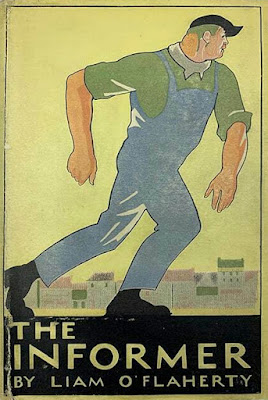
Dark Crime Novel, The Informer, by Liam O’Flaherty

Forget everything you might remember about the movie, “The Informer.” The book it was based on will knock you on your arse with its realism, squalor, crime, and violence.

In
Liam O’Flaherty’s 1925 novel of the same name, Gypo Nolan is not the lovable oaf played by Victor McLaglen in John Ford’s 1935 film. He is a beast roaming the slums of Dublin. O’Flaherty almost always describes the powerful giant with the slow brain in animal terms, except when comparing him to plants or rocks. 

Gypo Nolan is about as down and out as a person could get in the Ireland of the early 1920s. While the country was struggling to establish a new, independent government, political factions and splinter groups were fighting among themselves, inflation was on the rise and the poor were getting poorer. The only money Gypo could lay his his hands on was from beating and robbing sailors or through handouts from Katie Fox, an emaciated, drug addicted, prostitute. 

Once a police officer, Gypo was thrown off the force. He then got involved with a Communist organization looking to dominate the new government and in need of a thug. Sent to deal with a farm labor group, Gypo and his old pal Frank McPhillip got drunk and Frank shot and killed one of the farm leaders. This got both of them thrown out of the radical group. Frank, with a price on his head, was forced to hide in the countryside. Gypo returned to the slums of Dublin.

Living in a men’s shelter, Gypo is surprised to see Frank sneak in and tell him he is ill, possibly dying, and is going home to visit his parents. 

This puts an idea in Gypo's head. Tired of being broke, wanting a good meal and drinking money, he decides to go to the police, tell them where to find Frank, and claim the £20 reward (about £1,200 pounds or $1,500 in today’s money, but could have been a lot more due to the conditions of the time). 

In a skirmish with the cops, Frank is killed. 

Now, with the money in his pocket, Gypo goes right into a bar and starts drinking. The bartender is stunned when Gypo produces a pound note to pay. For a guy everyone knows is on the skids, pulling out a bill worth about $70 or more would be stunning. Katie Fox comes in, sees Gypo has money and starts cadging drinks off him and manipulating him to give her some cash. 

Carried away with his new prestige as a man of means, in one of the best scenes in the book, Gypo goes into a little fish and chips shop and buys food for anyone who wants to eat. He spends recklessly and a big crowd gathers. Among them is a member of the radical group of which Gypo was once a member.

The group and its leader, Dan Gallagher, now suspicious of Gypo and his new found wealth, haul him into a secret tribunal and get the truth out of him. He was the one who informed on Frank. Every member of the group is now in peril if Gypo ever goes to the cops again. Gypo is sentenced to die, but he escapes, runs through the streets like a frightened animal and is finally killed by the group. Before he dies, he stumbles into a church where Frank’s mother is praying and he asks her forgiveness. 

Unlike the sentimental movie, the ending of the book is graphic and unsettling. 

Another person in the story who emerges as a main character is Dan Gallagher, the young leader of the revolutionary group. Gallagher is a man committed to the Communist movement, but reveals to Frank’s sister, a young woman in love with him, that his – Gallagher’s – ideas and goals are not fully formed or even well thought out. He enjoys the power of leading men, but is confused about many things. 

Frank’s sister, Mary, is the only character who has a chance of escaping the slums and the wretched lives of the people around her. She finished school and got an office job in a Dublin company. If only there had been a little more about her, the book would not have been so bleak. But a dark, bleak tale is what O’Flaherty set off to tell and it is what he achieved. 

Liam O’Flaherty (1896-1984) was born in the rural Aran Islands, studied to be a priest for a while, fought in the English army in World War I, had Communist leanings, wrote 14 novels and many short stories and has been considered one of Ireland’s great, if overlooked authors. 

The Informer is a marvelous read, even if O’Flaherty, describing the squalor and poverty, lays it on a little thick. At times he also sails off on wordy tangents, waxing poetic and nearly forgetting the point he was trying to make. But those passages are few and do not take away from the power of the book and of O’Flaherty’s ability to describe the inner workings of Gypo's mind. 

Before leaving the impression that the novel is a grim slog, there are some funny moments in The Informer, as when Gypo beats up a man in the street and then beats up the cop who came to break up the fight, then searches for the tiny little hat he always wears:

“His massive round skull stood bare under the night. It stood naked, hummocked and gashed here and there, like a badly shorn sheep. He traversed the skull with his right palm, in little flurried rushes, as if he had had a vague suspicion that the hat was hiding somewhere along the expanse of skull.”

It is a brutal humor, but then, brutal is a good word for the book.

Friday, March 17, 2017

John Ford's "The Rising of the Moon"

Today is St. Patrick’s Day, and as they usually do every March 17, the cable channel, Turner Classic Movies, is showing Irish-themed films all day.

Tonight at 8 p.m., TCM is scheduled to show John Ford’s “The Rising of the Moon.” (But, please check your cable guides. The times can vary and schedules can be different outside the U.S.) .

“The Rising of the Moon,” from 1957, is an unusual little black and white film with no big-name stars, except Tyrone Power who introduces segments of the picture.


The movie is in three parts, each a separate and unconnected tale, based on short stories and plays by Frank O’Connor, Michael J. McHugh, and Lady Augusta Gregory, and adapted by long-time Ford collaborator, screenwriter Frank S. Nugent.

The first two stories are told with a gentle sense of nostalgia. The last is harder and tougher. All three parts were made with care and artistry on location in Ireland.

Don’t miss this one.

Tuesday, March 14, 2017

Don’t Bother Seeing “I See a Dark Stranger”

St. Patrick’s Day is approaching and, ironically, I happened to watch a film the other night with a distinctly anti-Irish tone. But then, most of the English characters in this movie did not come across too well, either.

“I See A Dark Stranger” is a 1946 war film set in Ireland and England in the weeks prior to the 1944 D-Day invasion. I was expecting a noir thriller, but was disappointed.

Bridie Quilty, played by Deborah Kerr, a young, obstinate and none-too-bright young Irish woman who spent her life listening to stories of fights for Irish freedom from the British, decides to serve her country against its ancient foe by becoming a Nazi spy in England.

While working diligently and unthinkingly for a nest of spies gathering information about the coming invasion, she attracts the amorous attention of a British officer, played by Trevor Howard. Why the Howard character would think Bridie anything but an ill-tempered idiot is beyond explaining. Bridie makes Maureen O’Hara’s Mary Kate Danaher of “The Quiet Man” look like an easy-going hippie girl.

“I See A Dark Stranger” is part adventure film, which the producers supposed would be in the mold of Hitchcock’s “The 39 Steps,” and part slapstick comedy with most of the slaps coming in the last 15 minutes of the picture. But this movie is a 100 percent mess, although a technically well-crafted mess.

The film was co-written and produced by the team of Sidney Gilliat and Frank Launder, with Launder directing. The two wrote the script for Hitchcock’s “The Lady Vanishes,” so this one should have been a lot better. But they did not have Hitch to guide them.

My advice is to skip “I See A Dark Stranger,” especially if you have any Celtic blood in your veins. You might want to skip it, too, if you are British because the movie is none too kind to your people either.

Now, so as not to leave you without a movie recommendation for March 17, do try to see John Ford's "The Rising of the Moon," Friday on Turner Classic Movies (in the U.S.). And, please check back here on St. Patrick's Day for a post on Ford's film.

Tuesday, November 29, 2016

Eastwood is a youngster compared to Oliveira

The other day, I was talking to someone about Clint Eastwood, saying he was remarkable for continuing to direct movies at his age. He is 86 now (born 1930) and his latest film, “Sully,” came out in September of this year (2016). Mr. Eastwood is defying the idea that the difficult, stressful and physically taxing job of directing films is a young person’s game.
Some of the Hollywood legends made films into their 70s. John Ford was about 71 when he made his last movie, “Seven Women.” Howard Hawks made his last, “Rio Lobo,” when he was 73. Alfred Hitchcock made “Family Plot” when he was about 76. Michael Curtiz did “The Comancheros” when he was about 75.

But Eastwood is unique, turning out movies well into his 80s.
And then I remembered an even more remarkably superannuated movie maker: Manoel de Oliveira.

A few years ago, I saw some of his films on DVD, and was amazed he was still creating at his age. But, when I looked him up the other day on the Internet Movie Database (IMDb), I was saddened to learn that he had died in 2015 at the age of 106.

Now here is the part that should knock you out: He made his last feature film in 2012 at the age of about 103. Let that sink in before I tell you that the IMDb also says he made a 15-minute documentary the year he died.

Mr. Oliveira was born in Portugal in 1908 and made films there starting in the silent era. Due the political climate of the country, his output was spotty until the 1970s, said Dennis Lim in his New York Times obituary of the director.

The three Oliveira films I have been able to view are:

“The Strange Case of Angelica” (2010). This is a strange one indeed. It is the story of a young man who falls in love with a young woman but can never be with her. The movie feels like it traveled through time from the silent era to the 21st Century. I saw it when I was researching a movement called Slow Cinema and I am here to tell you this one is slow – really slow. Luckily, I like a lot of the Slow Cinema productions.

“Belle Toujours” (2006) is the story of an older man who sees an old flame at a concert, pursues her, and after a time convinces her to have dinner with him. Secrets and a lot more are revealed at the dinner and the meal goes on in almost real time. Very slow, but fascinating.

“Taking a Picture” (2003) is several stories about people on a cruise ship. Some of the passengers, including Catherine Deneuve and Irene Pappas, spend a lot of time talking during meals at the captain’s table. John Malkovich plays the ship’s captain. Malkovich made several films with this director, as did Ms. Deneuve.

The films of Manoel de Oliveira are not for everyone, but anyone feeling a little adventurous and willing to let an old master do his thing – no matter how slowly – should give his movies a try.

(For more posts on movies and TV, check out Todd Mason’s blog.)